
 Download Duncan's illustrated historical e-book 1918 Spanish Flu Pandemic - Compared with Covid-19 - from Smashwords: click here >>
 Download Duncan's latest illustrated historical e-book Norsemen to Vikings - Early Scandinavian History - from Smashwords: click here >>
dMAC Free Bonus
dMAC Digest-History:
ANZAC & Lone Pine Revisited 1975
>>Download this free e-book
Illustrated Historical Novel:
Culann ~ Celtic Warrior Monk
>>Download this free e-book
Tuberculosis - TB |
Duncan MacDonald
Jakarta 23 March 2006
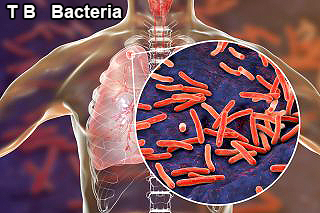
What! – Me Worried ?
Over the past 11 months all I have heard, read, or seen on TV relates to the increase of Coronavirus.
The COVID-19 Pandemic has had an unprecented impact on our current world. New cases continue to surge. There have been over 288,598,143 confirmed cases and 5,454,989 deaths as 1-Jan-2022. [1]
But let us consider for a moment, the havoc COVID has done to TB health services. Drug resistant TB wards converted to COVID wards, health workers diverted to COVID response, rapidly falling identified TB case numbers; the list goes on.
According to modelling analysis undertaken by the STOP TB partnership in association with Imperial College, Avenir Health, John Hopkins University and USAID, the impact of reduced availability and use of reduced availability of TB services is that 6.3 million more people will fall ill due to TB by 2025 and 1.4 million more will die - if immediate action is not taken.
These deaths will add to the 4,200 deaths already happening every day due to TB in the world. Lockdown is not yet over in many countries and recovery may take several months.
Every year more than 98,000 Indonesians die due to TB - more people than HIV/AIDS, Malaria and COVID-19. Indonesia is one of the highest TB burden countries in the world with an estimated 845,000 TB cases every year. Only 67 percent of cases are reported every year, which means 32 percent of cases are still not detected, still infecting the community and potentially not accessing treatment. [2]
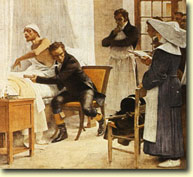
Doctors & nurses examining for TB
How many seminars, TV documentaries and magazine articles have you read lately about TB ? Not very many I'll warrant.
Why is this so?
One theory I'm hearing from my medical friends, tuberculosis doesn't get much air play because the great majority of the victims are in developing countries. And it's been around forever. On the other hand, Coronavirus is getting humungous additional funding by pushing the COVID-19 scare.I don't believe that for one minute. . . . . Well, not more than a couple of minutes anyway.
Should you be worried about TB?
First let's have a quick look at Tuberculosis 101.
History of TB
TB has been present in humans since antiquity. The origins of the disease coincide with the first domestication of cattle. Skeletal remains show prehistoric humans (4,000 BC) had TB.Around 460 BC, Hippocrates identified Phthisis (a Greek term for consumption) as the most widespread
 disease of the times, which was almost always fatal. [3]
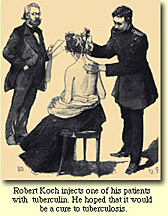
 German physician Robert Koch described the bacillus tuberculosis, Mycobacterium tuberculosis on 24 March 1882. He received the Nobel Prize in medicine in 1905 for this discovery. However Koch did not believe bovine (cattle) and human tuberculosis were similar, which held back the recognition of infected milk as a source of infection. Later this source was eliminated by pasteurisation.
The cause of tuberculosis (or consumption so named because sufferers appeared to be consumed by the disease from within, or Phthisis), Mycobacterium tuberculosis (MTB), is a slow growing aerobic bacterium that divides every 16 to 20 hours. This is extremely slow compared with other bacteria (E.coli is one of the fastest dividing approximately every 20 minutes).
Infection and Transmission
Tuberculosis is a contagious disease. Like the common cold, it spreads through the air when infectious people cough, sneeze, talk or spit. A person only needs to inhale a small number of the TB germs known as bacilli, to become infected. [4]TB is spread through the air. People cannot get infected with TB bacteria through handshakes, sitting on toilet seats or sharing eating utensils with someone who has TB.
You may contact Coronavirus by breathing in droplets when an infected person coughs, sneezes or talks. COVID-19 can survive up to 72 hours on plastic or stainless steel surfaces.
You do the math - While only 10% of TB infection progresses to TB disease, if untreated, the death rate is 51%.
Symptoms
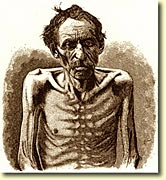
Symptoms of active TB includes; weakness, weight loss, fever, no appetite, chills, and sweating at night. If active TB disease is in the lungs (pulmonary TB) the symptoms may include a bad cough, pain in the chest and coughing up blood.Diagnosis
There are two kinds of tests used to detect TB bacteria in the body:(1) TB skin test (TST), and (2) TB blood tests.
A positive TB skin test only tells that a person has been infected with TB bacteria. It does not tell if the person has latent TB infection (LTBI), or has progressed to TB disease.
Other tests, such as chest X-ray and a sample of sputum, are needed to see if the person has TB disease.
HIV and TB form a lethal combination, each speeding the other's progress. HIV weakens the immune system. An HIV-positive person infected with TB is many times more likely to become sick with TB disease than someone who infected with TB who is HIV-negative
Drug-resistant TB Sixty years ago there were no medicines to cure TB. Now strains that are resistant to a single drug have been documented in every country surveyed, including Indonesia.
Poorly supervised or incomplete treatment is worse than no treatment at all. The patient may remain infectious and their lungs develop resistance to anti-TB medicines. People they infect will have the same drug resistant strain. [5]
 Indonesia ranks 3rd on the list of 22 high-burden tuberculosis countries in the world – after China and India. [6]
 The head of the TB elimination program in Lampung, Dr. Elvi Suryati, said a health office survey found that at least 10 people on virtually every block in one sub-district in the provincial capital Bandarlampung had tuberculosis. Seventy-five percent of people who developed active TB and eventually died of the disease were in their productive years, ranging in age from 15 to 49. [7]
TB has been classified as endemic in Bandarlampung, with three sub-districts being most susceptible to the spread of the disease. The survey found that 10 out of 11 people in each sub-district are believed to have contracted TB. This is the highest figure found throughout Indonesia. [8]
Effective TB control – DOTS
The DOTS strategy (Directly observed therapy), introduced in 1991, prevents new infections by curing infectious patients. A six month supply of drugs for treatment under the DOTS strategy costs as little as US$10 per patient.TB in Art, Literature, History & Film 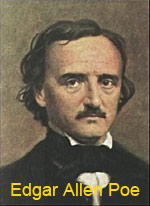
Many historically prominent people developed or died from tuburculosis, often in the prime of their productive period.The pale haunted appearance of tuberculosis sufferers was fashionable at times, and has been seen as an influence on the works of Edgar Allen Poe who lost loved ones to this disease.
It is tragic that this disease has not been brought under control, because I am living proof that TB can be effectively treated and cured" said Nobel laureate Archbishop Desmond Tutu, who along with former South African President Nelson Mandela is a survivor of TB. [9]
English romantic poet John Keats (1795-1921) and some of his family were taken by TB.
Frederic Chopin died of consumption in 1849.
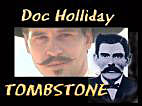
Famous dentist, gambler and gunslinger John "Doc" Holliday suffered from tuberculosis until his death in 1887. Doc and his bloody cough were portrayed by Val Kilmer in the 1993 film Tombstone.
Legendary father of country music, Jimmy Rodgers (1897 - 1933) wrote the song T.B. Blues. He died of the disease days after a New York city recording session.

Franz Kafka (1883-1924) a German-language novelist, made famous by his novel The Metamorphosis, died from TB.
In the period picture Camille, MGM 1936, consort Greta Garbo (Camille) tragically contacts consumption and dies in Robert Taylor's arms.
In Finding Neverland, Kate Winslet's character suffers and dies from tuberculosis.
In the novel The Constant Gardener by John Le Carre as well as in the award winning movie, the plot largely revolves around TB drugs being tested on unwitting subjects in Africa and dire predictions of a global pandemic if a drug-resistant form of the disease appears.
A word to the wise
Remember that 10 out of 11 people near Lampung have contracted TB. There is a high rate of TB in rural areas in Indonesia. Your pembantu (maid) most likely came from a kampung. Have your domestic staff tested for TB. Your children are most vulnerable to TB.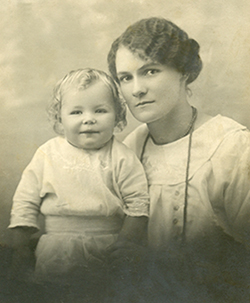
PERSONAL FOOTNOTE - from the Webmaster
My grand-mother, on my Mother's side, Imelda Mary White (Daisy), died of tuberculosis aged 30, in 1925.Daisy is pictured here with my Mother, Laurel, in 1919.
Laurel died of cancer, aged 40, in 1957.
 Stress Management
 Tennis Elbow
